Continuing to evolve his refined vision of American sportswear, Resort found Adam Lippes in a relaxed mood influenced by French visual artist Willy Daro’s decorative objets, which fuse together natural metals and stones. That inspiration was reflected in the collection’s emphasis on organic shapes, particularly evident in easy pieces such as paper-bag-waisted trousers, fluid silk slip or wrap dresses, and soft double-knit merino ponchos. Daro’s works also gave rise to the graphic foliage print found on Lippes’ boxy, thigh-grazing shift, which would look terrific with a pair of flats. Keeping in mind the season’s early November delivery window, Lippes was sure to offer plenty of transitional outerwear to take his customer into the colder months. Highlights included an unconstructed topper cut from ivory wool, backed in duchesse, as well as “monastic,” robe-like coats (in either boudoir-ready satin or luxe, brushed cashmere) with open slits along the sides that imparted a dynamic movement. Elsewhere, Lippes continued to elevate denim—a relatively new category that has met with retail success—in the form of boxy chambray tunics and indigo wrap skirts, which communicated an easy elegance that wasn’t too fussy.
—Brittany Adams
Runway Feed
Category Archives: home
Before & After Weight Loss Motivation Photos!!

I wanted to share these photos with you as motivation to help you achieve your fitness goals. Please be kind in your comments many of these pictures come fro…
Video Rating: 5 / 5
FOLLOW US ON INSTAGRAM http://instagram.com/officialhodgetwins Check Out Our Gym Merchandise http://officialhodgetwins.com/ FOLLOW US ON INSTAGRAM http://ins…
Video Rating: 4 / 5
Cool Before After Weight Loss images
Some cool before after weight loss images:
Steven F. Udvar-Hazy Center: View over World War Two aviation wing, including Japanese planes and B-29 Enola Gay
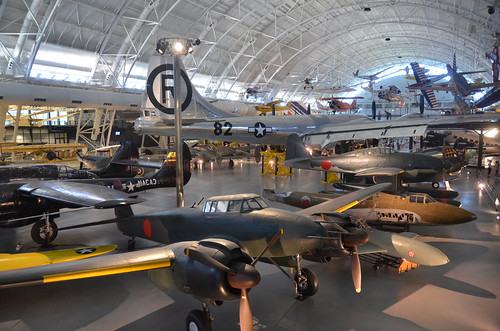
Image by Chris Devers
See more photos of this, and the Wikipedia article.
Details, quoting from Smithsonian National Air and Space Museum: Steven F. Udvar-Hazy | Nakajima J1N1-S Gekko (Moonlight) IRVING:
Originally designed as a three-seat, daylight escort fighter plane by the Nakajima Aeroplane Company, Ltd., and flown in 1941, the IRVING was modified as a night fighter in May of 1943 and shot down two American B-17 bombers to prove its capability. The Gekko (meaning moonlight) was redesigned to hold only two crewmen so that an upward firing gun could be mounted where the observer once sat. Nearly five hundred J1N1 aircraft, including prototypes, escort, reconnaissance, and night fighters were built during World War II. A sizeable number were also used as Kamikaze aircraft in the Pacific. The few that survived the war were scrapped by the Allies.
This J1N1 is the last remaining in the world. It was transported from Japan to the U.S. where it was flight tested by the U.S. Army Air Forces in 1946. The Gekko then flew to storage at Park Ridge, IL, and was transferred to the Smithsonian Institution. The restoration of this aircraft, completed in 1983, took more than four years and 17,000 man-hours to accomplish.
Transferred from the United States Air Force.
Manufacturer:
Nakajima Hikoki K. K.
Date:
1942
Country of Origin:
Japan
Dimensions:
Overall: 15ft 1 1/8in. x 41ft 11 15/16in., 10670.3lb., 55ft 9 5/16in. (460 x 1280cm, 4840kg, 1700cm)
Materials:
All-metal, monocoque construction airplane
Physical Description:
Twin-engine, conventional layout with tailwheel-type landing gear.
Armament: (2) 20 mm fixed upward firing cannon
Engines: (2) Nakajima Sakae 21 (NK1F, Ha35- 21) 14- cylinder air-cooled radial 1,130 horsepower (metric)
• • • • •
See more photos of this, and the Wikipedia article.
Details, quoting from Smithsonian National Air and Space Museum: Steven F. Udvar-Hazy | Boeing B-29 Superfortress "Enola Gay":
Boeing’s B-29 Superfortress was the most sophisticated propeller-driven bomber of World War II and the first bomber to house its crew in pressurized compartments. Although designed to fight in the European theater, the B-29 found its niche on the other side of the globe. In the Pacific, B-29s delivered a variety of aerial weapons: conventional bombs, incendiary bombs, mines, and two nuclear weapons.
On August 6, 1945, this Martin-built B-29-45-MO dropped the first atomic weapon used in combat on Hiroshima, Japan. Three days later, Bockscar (on display at the U.S. Air Force Museum near Dayton, Ohio) dropped a second atomic bomb on Nagasaki, Japan. Enola Gay flew as the advance weather reconnaissance aircraft that day. A third B-29, The Great Artiste, flew as an observation aircraft on both missions.
Transferred from the United States Air Force.
Manufacturer:
Boeing Aircraft Co.
Martin Co., Omaha, Nebr.
Date:
1945
Country of Origin:
United States of America
Dimensions:
Overall: 900 x 3020cm, 32580kg, 4300cm (29ft 6 5/16in. x 99ft 1in., 71825.9lb., 141ft 15/16in.)
Materials:
Polished overall aluminum finish
Physical Description:
Four-engine heavy bomber with semi-monoqoque fuselage and high-aspect ratio wings. Polished aluminum finish overall, standard late-World War II Army Air Forces insignia on wings and aft fuselage and serial number on vertical fin; 509th Composite Group markings painted in black; "Enola Gay" in black, block letters on lower left nose.
Boeing B-17G Flying Fortress

Image by Alex Layzell
History: The B-17, arguably World War II’s most famous heavy bomber, first flew on July 28, 1935, before a crowd of reporters eager to see Boeing’s new bomber take wing. It was dubbed the "Flying Fortress" by the members of the press in attendance because of its (at least for the time) heavy defensive armament. The prototype crashed in October, but because of its impressive speed and handling the US Army Air Corps (USAAC) decided to continue testing anyway. They ordered 13 YB-17s for further evaluation, a decision that would prove momentous in years to come.
The YB-17 had five machine guns, room for 4,800 pounds of bombs and a crew of nine. It had electrically retractable landing gear. After testing the YB-17, an improved prototype, the Y1B-17, was built with Wright Cyclone radial engines. Twelve were delivered to the USAAC’s 2nd Bombardment Group for trials. One of these was soon equipped with new Moss/General Electric turbochargers that became standard on all future Flying Fortresses. The first production order was for 39 B-17Bs with turbo-charged engines, and as soon as these were under production another order for the B-17C was placed, with seven machine guns instead of the original five.
The RAF received their first B-17Cs in 1941, and were soon conducting daylight raids over Germany. The defensive armament soon proved inadequate, and the B-17’s altitude was little defense against the German fighters. Orders for the B-17D were soon placed with self-sealing fuel tanks and more armor because of lessons learned in bombing missions over Europe. The B-17E and B-17F soon followed with larger tail. The B-17F was the first to serve with the USAAF 8th Air Force. After suffering staggering losses in late 1943, analysis proved head-on attacks by enemy fighters were a distinct problem. The final major version, the B-17G, added a chin turret with dual machineguns. This gave the B-17 a defensive armament of 13 guns.
After the war, several dozen B-17s lived on as fire-bombers and aerial surveyors until the last one was retired in the 1970s. Today, a few B-17s have been restored to their wartime splendor. Eleven are currently flying in the United States, one in the UK and another one in France. [History by David MacGillivray]
Nicknames: Fort; The Flying Coffin (Nazi propaganda nickname)
Specifications (B-17G):
Engines: Four 1,200-hp Wright R-1820-97 Cyclone turbocharged radial piston engines
Weight: Empty 36,135 lbs., Max Takeoff 65,500 lbs.
Wing Span: 103ft. 9in.
Length: 74ft. 4in.
Height: 19ft. 1in.
Performance:
Maximum Speed: at 25,000 ft: 287 mph
Cruising Speed: 182 mph
Ceiling: 35,800 ft.
Range: 2,000 miles with 6,000 lb. bomb load
Armament:
13 12.7-mm (0.5-inch) machine guns
Up to 17,600 pounds of bombs
info from www.warbirdalley.com/b17.htm
Steven F. Udvar-Hazy Center: Air France Concorde
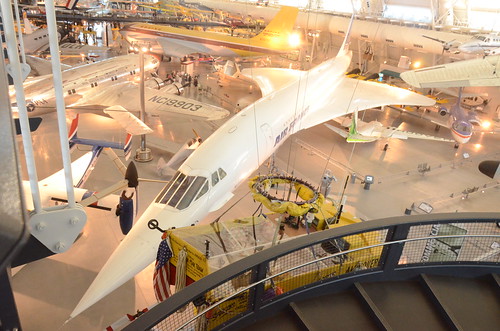
Image by Chris Devers
Quoting Smithsonian National Air and Space Museum | Concorde, Fox Alpha, Air France:
The first supersonic airliner to enter service, the Concorde flew thousands of passengers across the Atlantic at twice the speed of sound for over 25 years. Designed and built by Aérospatiale of France and the British Aviation Corporation, the graceful Concorde was a stunning technological achievement that could not overcome serious economic problems.
In 1976 Air France and British Airways jointly inaugurated Concorde service to destinations around the globe. Carrying up to 100 passengers in great comfort, the Concorde catered to first class passengers for whom speed was critical. It could cross the Atlantic in fewer than four hours – half the time of a conventional jet airliner. However its high operating costs resulted in very high fares that limited the number of passengers who could afford to fly it. These problems and a shrinking market eventually forced the reduction of service until all Concordes were retired in 2003.
In 1989, Air France signed a letter of agreement to donate a Concorde to the National Air and Space Museum upon the aircraft’s retirement. On June 12, 2003, Air France honored that agreement, donating Concorde F-BVFA to the Museum upon the completion of its last flight. This aircraft was the first Air France Concorde to open service to Rio de Janeiro, Washington, D.C., and New York and had flown 17,824 hours.
Gift of Air France.
Manufacturer:
Societe Nationale Industrielle Aerospatiale
British Aircraft Corporation
Dimensions:
Wingspan: 25.56 m (83 ft 10 in)
Length: 61.66 m (202 ft 3 in)
Height: 11.3 m (37 ft 1 in)
Weight, empty: 79,265 kg (174,750 lb)
Weight, gross: 181,435 kg (400,000 lb)
Top speed: 2,179 km/h (1350 mph)
Engine: Four Rolls-Royce/SNECMA Olympus 593 Mk 602, 17,259 kg (38,050 lb) thrust each
Manufacturer: Société Nationale Industrielle Aérospatiale, Paris, France, and British Aircraft Corporation, London, United Kingdom
Physical Description:
Aircaft Serial Number: 205. Including four (4) engines, bearing respectively the serial number: CBE066, CBE062, CBE086 and CBE085.
Also included, aircraft plaque: "AIR FRANCE Lorsque viendra le jour d’exposer Concorde dans un musee, la Smithsonian Institution a dores et deja choisi, pour le Musee de l’Air et de l’Espace de Washington, un appariel portant le couleurs d’Air France."
Top 10 male idols with the best body proportions
Top 10 male idols with the best body proportions
Episode 13 of Mnet's Super Idol Chart Show hosted by Super Junior's Ryeowook and BEAST's Dongwoon lists ten idols who have the most ideal body proportions; statistics and explanations included! The list was determined by the calculation of 1534 …
Read more on hellokpop
The Enduring Promise of a Thinner You
Candace had just had her photo and measurements taken by Dr. David E. Halpern, a plastic surgeon from Tampa, Fla., who offers the device in his practice. Now he gave her the Strawberry … The aesthetic medical industry has its own name for the …
Read more on New York Times
7 tricks to avoid getting sick in winter
7 tricks to avoid getting sick in winter
The shorter days and longer nights are the perfect time to top up on rest, and your body needs it to keep immunity strong and heal from any infections. However, try not to increase your average sleep time by more than an hour, otherwise this can …
Read more on Courier Mail
5 Things You Need To Know About Weight Training (Yes, You Should Do It!)
Seriously jacked up bodies? Intimidatingly heavy looking dumbbells? Chest-bumping bros? If any of those mental images have scared you away from the weight room, you're missing out. Because as great as cardio is, weight training is the perfect …
Read more on Bustle
Taryn Brumfitt Video Reveals Women Find Their Bodies 'Disgusting': What Can …
She was lauded for showing a real, un-airbrushed view of women's bodies and is part of a bigger movement celebrating real bodies, rather than the airbrushed, personal-trainer-sculpted abs we're so used to seeing. She started a website, The Body Image …
Read more on Yahoo Finance UK
Louis Vuitton
There was a tender typewritten note from Nicolas Ghesquière on every seat at his first show for Louis Vuitton this morning. “Today is a new day. A big day…Words cannot express exactly how I am feeling at this moment…Above all, immense joy.” Emotions were high in the crowd, too. Few designers are as beloved, respected, or copied as Ghesquière is, and he’s been off the scene and badly missed since his departure from Balenciaga a year and a half ago. Only Raf Simons’ debut at Dior was as breathlessly anticipated as Ghesquière’s at Vuitton. They’re the jewels in Bernard Arnault’s LVMH crown, and Arnault was in the front row today, seated alongside Princess Charlene of Monaco and other lights from the worlds of film (Catherine Deneuve), art (Cindy Sherman), and fashion. Jean Paul Gaultier, for whom Ghesquière worked early on, turned up, as curious as the rest of us to see what the new LV, after fourteen years of Marc Jacobs at the helm, would look like.
As the metal blinds of the Cour Carree show space opened to bright sun, Freja Beha Erichsen emerged in a black leather snap-front coat with a wide caramel-colored collar, carrying the new Petite Malle bag, a miniature LV trunk at her fingertips. The coat’s flared A-line cut and abbreviated thigh-high hem was the show’s predominant silhouette, but if that shape cued a 1960s vibe, the workmanship was 21st-century state of the art. “The knowledge of the team is extraordinary, the best of the world,” Ghesquière said afterward, clearly delighted to be back at the red-hot center of things. You won’t find a more luxurious coat than the black crocodile shown here, despite its industrial zip front, or a jacket as well made as the one he patchworked in different colored leathers.
Naturally, there were a lot of skins, a lot of suede, a lot of leather, and naturally Ghesquière used them in innovative ways. A pair of cool evening looks had molded leather bodices and knit skirts aswirl with hand-cut feathers. Elsewhere, the designer’s famous flair for experimentation was somewhat scaled back. (That mostly holds true for the bags as well, save for a double-handled style that in fact came with just one handle.) “I will not say it was effortless, but it was a much more natural and easy process,” he went on. “I listened to the girls in the studio a lot, the women around me, what they want, what they need.” That came across in an outfit like the checked three-button blazer accompanied by glossy leather jeans and a red cardigan with a frilly white collar underneath, and in another that consisted of a white turtleneck, a trim black jacket, and a skirt in wool and crinkly leather, the new LV suit. And in a third that was as straightforward as a ski sweater and a belted A-line mini can be. Skirts and dresses were squarely the focus, yet fans of Ghesquière’s life-changing trousers could take heart at the sight of a high-waisted style into which he tucked a khaki jacket. In any case, there will be plenty of seasons for pants. This was a great beginning, understated but not without power, for Ghesquière and the new Louis Vuitton.
—Nicole Phelps
Runway Feed
Going Beyond Going Down: Why Diverse Queer Sex On TV Matters
Going Beyond Going Down: Why Diverse Queer Sex On TV Matters
Even very capable female characters still have to fit into the dominant narrative of dainty and perfect (Lara Croft comes to mind — good at what she does, also attractive and available to men). I want to add to Fleming's assertion that mainstream …
Read more on Autostraddle
Mom Taryn Brumfitt Starts a Revolution With Inspiring Body Image Movement …
The Australian native has launched the Body Image Movement, sharing her story to inspire other women to embrace their bodies no matter their shape or size. She made headlines this week when she did what most people could never do: She stripped down …
Read more on Life & Style Weekly
Miu Miu
Miuccia Prada started her personal revolutionary role in the fashion industry with one simple item: a black nylon rucksack. She took the banal, the ordinary, the everyday and made it desirable, luxurious, and special. She started to design and define what luxury could be by the appropriation of the normal. What she presented at Miu Miu today was a continuation of that task. A task and a collection that was so enjoyably witty, subversive, and skewed that it reached new heights of the “avant-bland.”
Prada frequently returns to normality; she often revels in it. This is not to say that she just presents something desultorily and day-to-day, then shoves it on a catwalk—that’s not fashion, after all. Instead she designs, re-contextualizes, and skews. Prada makes you think as well as laugh, and above all she infects you with a desire for quilted nylon from the bottom of your heart. And that’s because, well, she has a desire for quilted nylon from the bottom of her heart. “Everybody thought I was crazy with this, with the amount of times we tried getting this right,” the designer said of the key fabric of the collection. “I worked for one month on the right windbreaker that was not puffy-puffy. The perfect windbreaker—I had to get it right.”
“I am fixated on the notion of no useless design,” Prada continued. “Ideas are a different thing. But when things are overdone from nothing, I can’t stand it; it had to be more real, more wearable, less pretentious. What is normal, what is real, is what is important. In Paris you go slightly more grand, but this time I went, ‘Who cares?'”
Who cares, indeed. Prada covered the entire Palais d’Iéna in clear plastic, from floor to columns, echoing that Prada code of the clear plastic mac that made a familiar appearance in the collection and was added to by skirts, tops, and boots. The rest of the venue was covered in rough scaffolding; again utilitarian—you sat on it. A mini version of the supportive metal scaffolding poles was formed as heels for shoes. Above all, the designer presented a new kind of Miu Miu girl, one more stripped down and utilitarian than ever before. This was a girl that would not be out of place in the north of England, wearing a ski jacket and a school uniform, eating crisps at a bus stop in 1986, like a Rita or a Sue from an Alan Clarke film. Re-contextualized in this highest of fashion settings, she was aggressively normal, avant-bland, normcore.
Yet as the show progressed, she became more and more extravagant. As Tori Amos’ version of “Enjoy the Silence” was replaced by a dance mix of Depeche Mode’s original, the girl exploded into quilted brocades that looked to have Lurex running through them, her home knits revealing delicate underwear underneath. Intricate metal appliqués appeared on plastics—the silhouettes were similar, but the fashion came to the fore. Yet you were still left with the lingering impression of the start: the quilted nylons, the windbreakers, and the everyday. “Normality is weird,” said Mrs. Prada. And in fashion, that is undoubtedly true.
—Jo-Ann Furniss
Runway Feed
Jessica Simpson Flaunts Sexy Body in New Swimsuit Pics on Instagram
Jessica Simpson Flaunts Sexy Body in New Swimsuit Pics on Instagram
Jessica Simpson (Photo : Instagram / jessicasimpson) After successfully losing weight after giving birth to her son Ace last June 2013, Jessica Simpson has “proudly” showed off her toned slim figure in two new swimsuit photos she posted on Instagram, …
Read more on Fashion Times
Love Your Body: 5 Sexy Perks Of Being Pregnant
Guys open up about how much they love their wives' and girlfriends' brand new curves. You have tons of stuff to think about right now: Will my baby be healthy? What sort of mom will I be? How long will it take my belly to go down after birth and will I …
Read more on YourTango
Hermès
The Hermès show was staged in the Palais Brongniart. It was once the stock exchange, which made it an appropriate location for a presentation from a label whose name is a global byword for luxury. It also made the atmosphere all the more striking: There wasn’t a moment of ostentation, just dark velvet curtains with a twenty-foot drop, a sense of shadowy mystery, and Echo & the Bunnymen on the soundtrack. Stealth wealth, indeed.
Christophe Lemaire wouldn’t want it any other way. The woman he envisions for Hermès is remarkably consistent with the creature that populates his own collections: She’s a little bit mysterious, a little bit exotic, and fiercely independent. After the show tonight, Lemaire mentioned the Russian steppes, the ancient East-West trading route known as the Silk Road, and Persian carpets as reference points. It was easy to see the carpets in his dense, rich prints, and a Mongolian horsewoman might recognize some of the designer’s proportions. The coat in shaggy goat was as wild as the wind.
Lemaire said he’d been musing on all the characters a woman could be. But it wasn’t really those ethnic personae who carried the show. His notions of a strong, graceful, urban style were more persuasive. He tipped his cap to trends—lush knitwear, oversize
coats—but the slightly exaggerated proportions of his jackets and pants once again seemed more of a reference to Martin Margiela’s tenure at Hermès, and were just as elegantly slouchy, especially in an ivory tux with an extravagant shawl collar, or a coat-dress, also in ivory, that was closed with a single button.
About that stealth wealth: Lemaire offered a tunic in paper-light chiffon crocodile, pinned at the back, casually falling open from a single closure at the back of the neck. Such ease, combined with the utter luxury of the material, defines Hermès. In fact, with Véronique Nichanian as creative director for the men’s collection and Lemaire in charge of womenswear, the company now puts forth an idiosyncratic but completely convincing statement about luxury dressing in the twenty-first century.
—Tim Blanks
Runway Feed